
24 October 2026 · Property & Conveyancing · By Ryan Michael & Associates
Download PDF (10 pages · 724 KB)

The government wants to update the law that controls building plans in South Africa. If the new Bill is passed, more home improvements will need municipal approval, and the rules on refusals, appeals and penalties will change. The Bill is not law yet, so there is still time to get your property in order.
Where the Bill stands
The National Building Regulations and Building Standards Amendment Bill, 2026 (“the Bill”) is a draft proposal to change the National Building Regulations and Building Standards Act of 1977 (“the Act”). The Act is the law that every municipality uses when it approves building plans.
The Department of Trade, Industry and Competition published the Bill for public comment on 3 July 2026, and comments closed on 3 September 2026. The Department is now considering the comments it received. After that, the Bill still has to go to Cabinet and Parliament, be signed by the President and be given a start date.
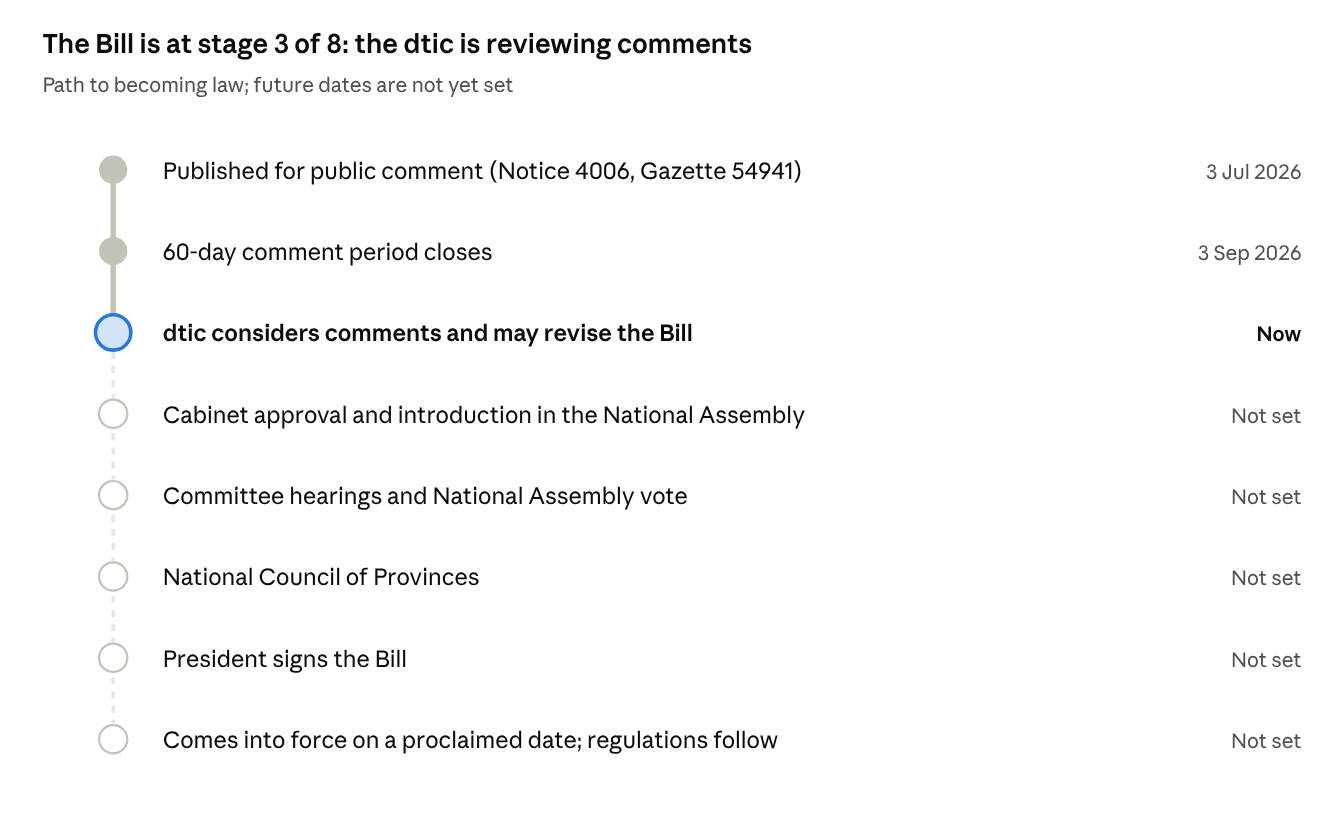
Until the Bill becomes law, nothing changes and the current rules still apply. The Bill also does not say what will happen to building work that already exists when it starts, so it is not yet clear whether older structures will be affected.
What would change: the six main points
1. More things would need plan approval
At the moment the Act covers houses, walls, swimming pools and similar structures. The Bill adds pergolas, water features, advertising signs, cellphone masts and earthworks such as terraces, trenches for pipes and services, and landfill sites. It also replaces the words “electricity supply” with “energy supply”, which brings solar panels, batteries and other energy systems serving a building clearly within the definition. Even small “minor works” are expressly included.
Covered areas such as carports and verandas would also count towards a building’s size. Where a building’s area is 500 m² or more, the municipality has 60 days to decide instead of 30, so more projects may wait longer for a decision. A Hillcrest family that adds solar panels, a battery room and a pergola would need municipal approval for each of them, or at least the building control officer’s written authorisation where the work qualifies as minor building work.
2. Plans could no longer be refused just because of how a building looks
Municipalities can currently turn down plans if a building would be unsightly or would lower the value of the neighbours’ homes. The Bill removes these reasons, so plans could only be refused if they do not comply with the Act, its regulations or other applicable laws such as the town-planning scheme, or if the building would be dangerous to life, property, health, the safety of its occupants or the environment.
A neighbour in Umhlanga who simply dislikes the look of your new room would therefore no longer be able to block it on that basis, although estate rules and title deed conditions would still apply. Similar wording does remain in other parts of the Act, so some objections may simply take a different route.
3. Appeals would go to your own municipality
If your plans are refused, or you disagree with a municipal prohibition notice or the way the building regulations have been applied, you can currently appeal to a review board whose chairperson is designated by the national Minister. The Bill scraps that board, and you would instead appeal to your own municipality’s appeal authority within 21 days of being told about the refusal. If that appeal fails, you could still ask the High Court to review the decision.
Appealing locally may be quicker and cheaper. The drawback is that the appeal would be decided by the same municipality that refused the plans, and the Bill itself sets no time limit for a decision, although a municipality’s planning by-laws may do so.
4. A court order would be needed before demolition or eviction
At present a municipality can order people to demolish or leave a dangerous building simply by sending a written notice. Under the Bill, it would first need a court order, except in a genuine emergency where immediate steps are needed to protect life, property or the environment. A municipality could still, without a court order, require an owner to have a dangerous building investigated by an architect or engineer, and order that dangerous work stop. This protects people living in run-down buildings, such as some in the Durban CBD, although it may slow down action against buildings that are truly unsafe.
5. Heavier penalties, and trustees can be held responsible
The Act’s general penalty clause currently refers to a fine of up to R4 000 or up to 12 months (one year) in prison. The Bill removes the R4 000 figure, leaving the court to set the fine within the limits of its jurisdiction, and increases the longest possible prison sentence to two years. The penalties table further on explains these terms in more detail.
The Bill also spells out who counts as the “owner” of a property. The Act already treats executors, curators and liquidators as owners in certain cases. The Bill adds the trustees of a trust, the owner of a sectional title unit for its interior, the trustees or administrator of a body corporate for common property, business rescue practitioners and the former members of a deregistered close corporation. If a family trust owns a house in Ballito, the trustees would be the “owner” for the purposes of the Act, so municipal notices would be addressed to them and they would be responsible for compliance.
6. Government buildings would have to follow the rules
The Act does not currently bind the State, which only has to lodge its plans with the municipality for information. Under the Bill the Act would bind the State, so schools, clinics and government offices would have to comply like any other building. Buildings on the surface of mining land would also be covered, with only underground mine buildings remaining exempt.
The Bill also creates a new national advisory committee on building matters and gives the Minister wider powers to make building regulations on sustainability and resource efficiency, and on universal access for people with disabilities. No regulations under these new powers have been published yet.
At a glance: the Act today and the Bill
| Topic | The Act today | Under the Bill |
|---|---|---|
| What needs approval | Houses, walls, pools and services | Also pergolas, water features, signs, masts, earthworks and all energy systems, including solar panels and batteries |
| Reasons to refuse plans | Does not comply, is dangerous, is unsightly or lowers neighbours’ values | Does not comply with the Act or other laws, or is dangerous to people, property, health or the environment |
| Where to appeal | A national review board | Your municipality, within 21 days |
| Unsafe buildings | Demolition or eviction by written notice | Court order needed first, except in an emergency |
| General penalty | Fine of up to R4 000, or up to 12 months in prison | Fine set by the court, or up to 2 years in prison |
| Who counts as the owner | The registered owner, and in some cases an executor, curator, liquidator or agent | Also trustees of trusts, body corporate trustees, unit owners and business rescue practitioners |
| Government buildings | Not bound; plans lodged for information only | Must comply |
| Occupancy certificates and decision times | 14 days for certificates; 30 or 60 days for plans | No change |
Penalties
| Offence | The Act today | Under the Bill |
|---|---|---|
| General offences under the Act | Fine of up to R4 000, or up to 12 months (1 year) in prison | Fine set by the court, or up to 2 years in prison |
| Staying in a building after a safety notice | R100 for each day | Fine set by the court, or up to 12 months (1 year) in prison |
| Building without approved plans | R100 for each day | No change: R100 for each day |
| Ignoring a municipal notice prohibiting building work | R100 for each day | No change: R100 for each day |
The prison terms in the table are maximum sentences, meaning the longest period a court is allowed to impose. Twelve months and one year are the same length of time, and the Bill would double the longest possible sentence for general offences to two years. A court looks at the facts of each case and may impose a much lighter sentence, or a fine on its own. Where the table says “fine set by the court”, the Bill no longer states a maximum amount, so the court decides what is appropriate within the limits of its jurisdiction. Older fixed amounts such as R4 000 may, in any event, already be increased in practice by the Adjustment of Fines Act 101 of 1991. Building without approved plans would, however, still carry the 1977 penalty of R100 for each day the work continues.
How plan approval would change
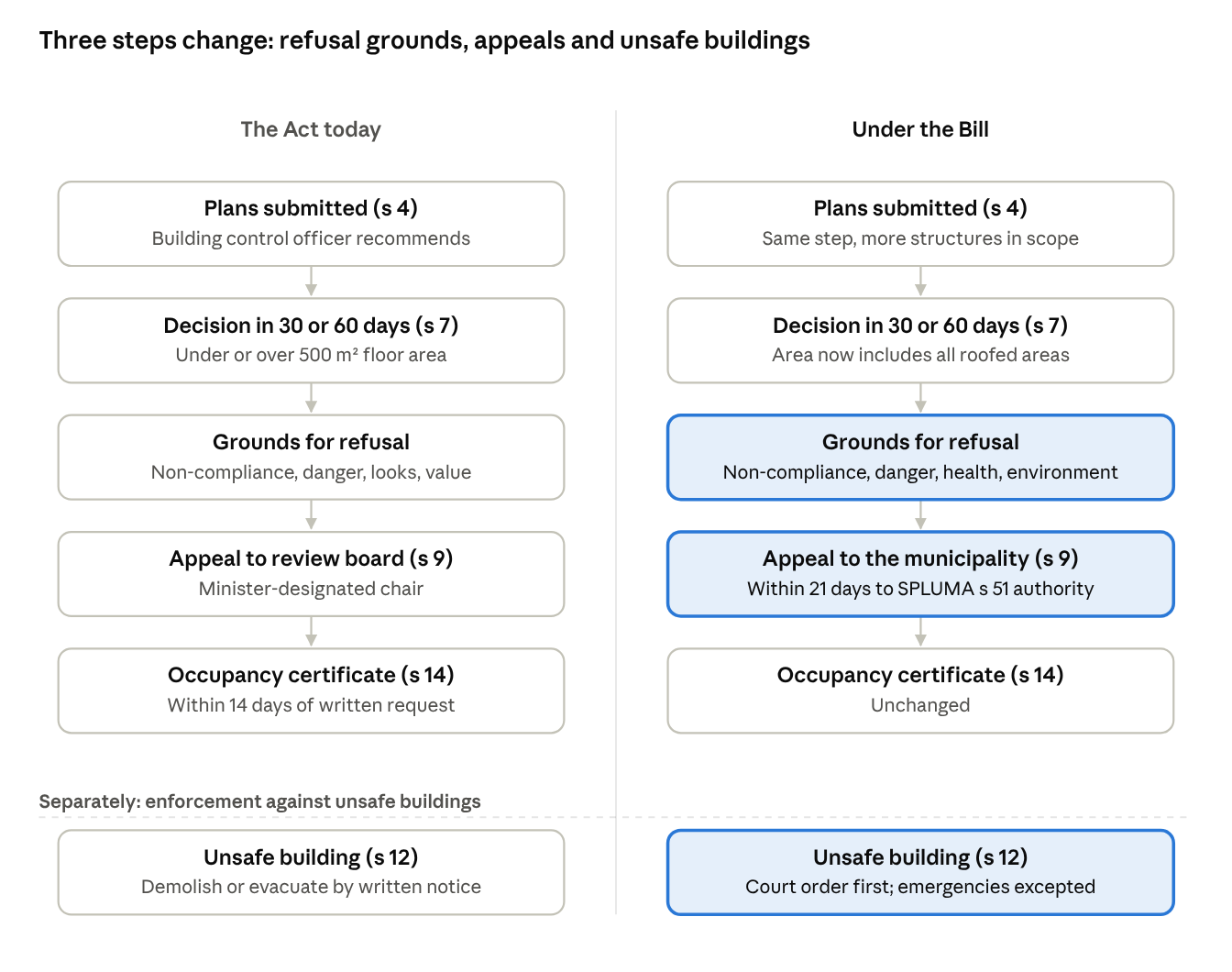
The diagram compares the approval process today with the process under the Bill. Only the three highlighted steps would change; submitting plans, decision times and occupancy certificates stay as they are.
Who is affected
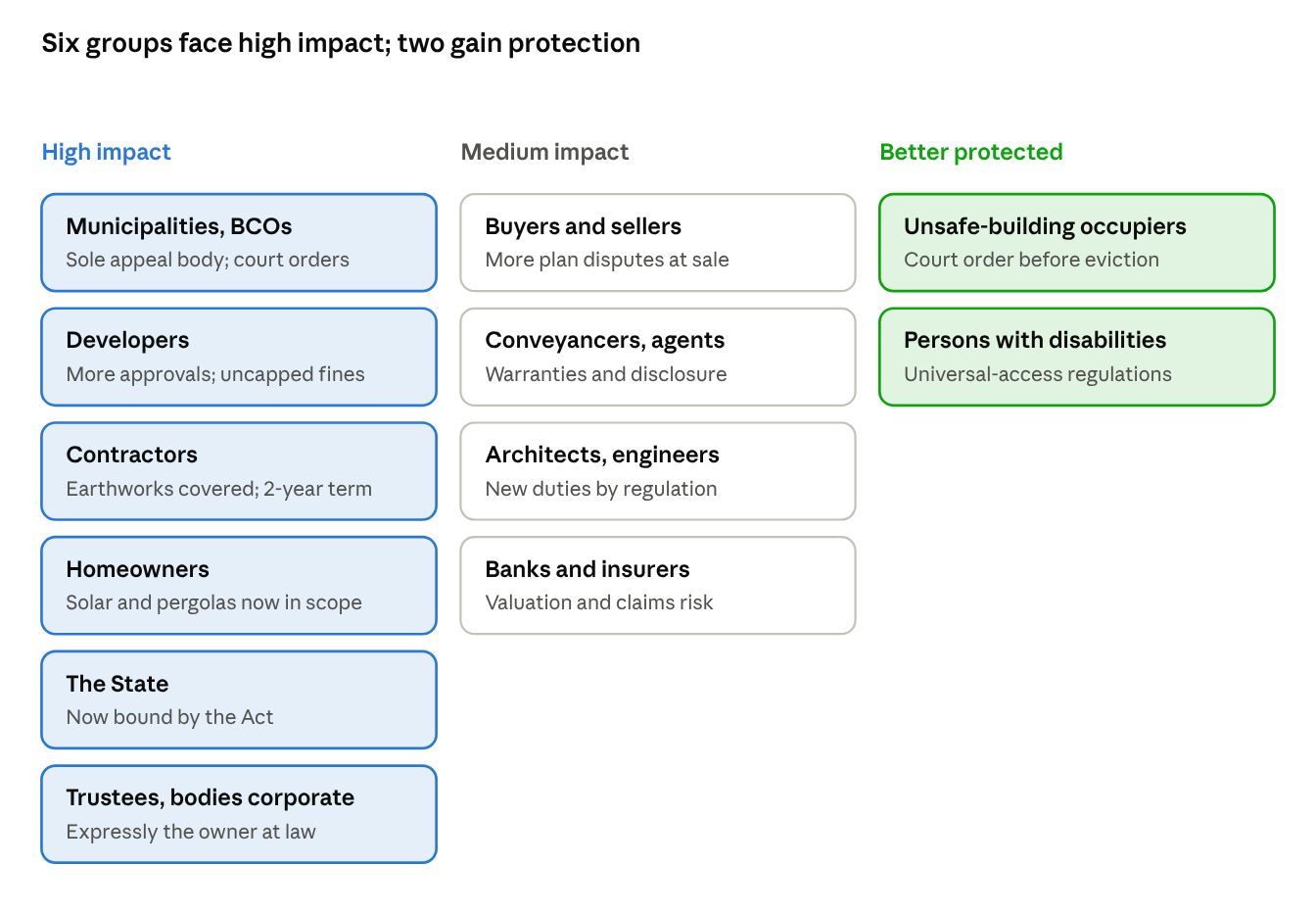
Municipalities, developers, contractors and homeowners would carry the heaviest load under the Bill, while people living in unsafe buildings and persons with disabilities would gain new protection.
Buying and selling property
Sale agreements
Most sale agreements include a promise by the seller that everything on the property has approved plans. Under the Bill that promise would also cover solar systems, battery rooms, pergolas and similar features, so these should be named in the agreement and in the mandatory disclosure form that is completed when an estate agent is involved.
Selling voetstoots
Selling voetstoots means the buyer accepts the property as it is, faults and all. It does not protect a seller who knew about an unapproved structure and kept quiet about it.
Trusts and sectional title
The trustees of a trust would be treated as the owner in their own right. In a sectional title scheme, each owner is responsible for the inside of their unit and the body corporate trustees for the common property, so a patio roof on common property would need an application by the trustees.
Bonds, insurance and occupancy certificates
Banks and insurers look closely at approved plans, so unapproved additions can lower a valuation or complicate an insurance claim. Occupancy certificates, which confirm that a finished building may be used, are not changing, and the municipality must still decide whether to issue one within 14 days of a written request.
Title deed conditions and estates
The Minister would lose the power to remove restrictive title deed conditions by notice, so owners would need to use the procedures under the Spatial Planning and Land Use Management Act and their municipality’s planning by-laws instead. Executors and liquidators already count as owners under the Act, and the Bill adds business rescue practitioners, so anyone acting in these roles should check the plan status of a property early when selling it.
Our view
Overall, the Bill is a sensible step towards fairer and more modern building rules, but some details are still unclear and the final version may look different.
| What works well | What raises concern |
|---|---|
| Ends refusals based on looks or neighbours’ property values | Similar wording survives elsewhere in the Act |
| Court protection before demolition or eviction | Action on dangerous buildings may be slower |
| The same rules for government buildings | Appeals are decided by the municipality that refused the plans |
| Clear rules on who counts as the owner | Trustees and practitioners may carry risk for problems they did not cause |
| Modern scope, including solar and masts | More small projects will need approval |
| New rules on energy use and disability access | Penalties are uneven, and some rules await regulations |
What to do now
If you are a homeowner or seller
- Check that every structure has approved plans: solar panels, battery rooms, pergolas, water features, outbuildings and earthworks.
- If anything is missing, start the approval process now.
- Disclose plan status honestly when you sell.
If you are buying property
- Ask for approved plans for every structure before you sign.
- Check your bank’s valuation and bond conditions for unapproved improvements.
If you are a trustee or serve on a body corporate
- Audit trust property and common property for unapproved or unsafe work.
- Make sure plan applications for common property are trustee-led.
If you are a developer or contractor
- Budget time and cost for approvals of earthworks, signage and masts.
- Plan programmes around the 60-day decision period for larger projects.
For any applicant once the Bill becomes law
- Diarise the 21-day appeal deadline from the date you are notified of a refusal.
- Note the Act’s new short name, the “National Building Act, 1977”, in contracts and forms.
How we can help
If you are planning to build, buy or sell, it is worth checking the plan status of your property before the law changes. We can review your plans, prepare and negotiate sale agreements, advise trustees and bodies corporate, and assist with municipal appeals and court reviews.
Ryan Michael & Associates
Attorneys | Notaries | Conveyancers
Office: +27 (0)31 030 0808
WhatsApp: +27 (0)73 074 7276
Email: info@rmattorneys.africa
Website: www.rmattorneys.africa
Head Office: 15 Stanley Grace Crescent, Umhlanga Rocks, KwaZulu-Natal, South Africa
Branch Office: 12 Warrior Road, Hillcrest, KwaZulu-Natal, South Africa
Download PDF (10 pages · 724 KB)
Sources
- National Building Regulations and Building Standards Amendment Bill, 2026 — Government Gazette 54941, Notice 4006 of 2026
- National Building Regulations and Building Standards Act 103 of 1977 (SAFLII)
- gov.za notice and comment date
- dtic notice page
Important notice and disclaimer
This article is published by Ryan Michael & Associates for general information only. It summarises a draft Bill that may change before it becomes law and does not constitute legal advice or a legal opinion from Ryan Michael & Associates or any of its attorneys. It should not be relied on or construed as such, and reading it does not create an attorney–client relationship. Ryan Michael & Associates accepts no liability for any loss or damage arising from reliance on this article, or from any action taken or not taken on the strength of it.
Readers who have questions about the Bill, the contents of this article or how the proposed changes may affect them should obtain proper legal advice, either from Ryan Michael & Associates or from their own legal representatives, before making any decision.